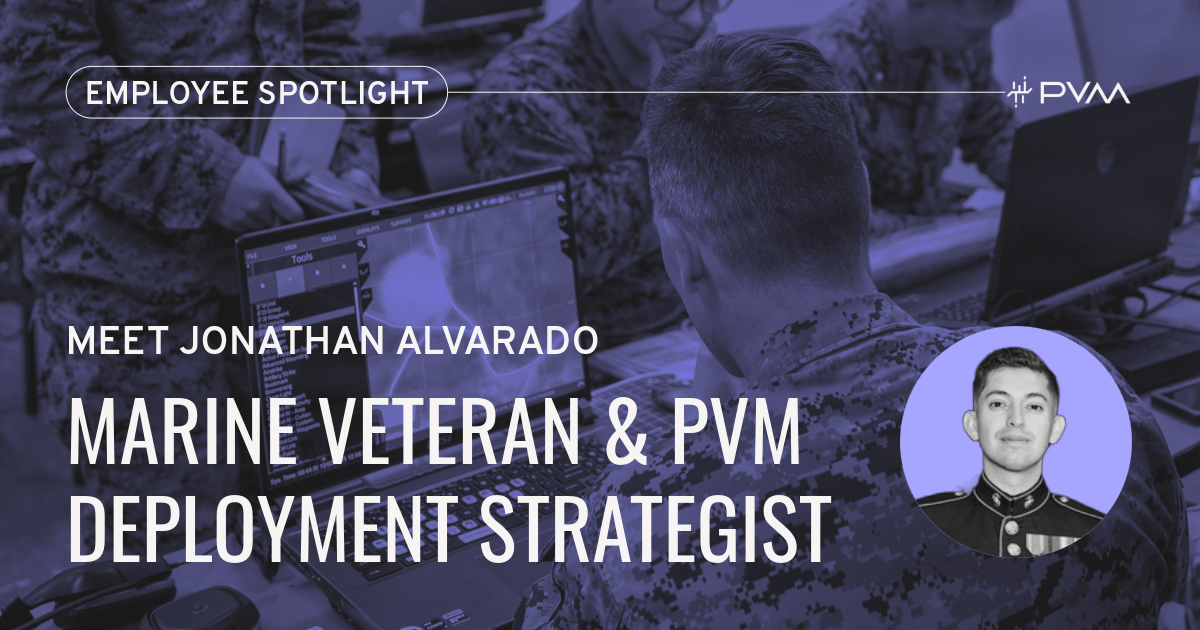
From the flight lines of Japan to embassy operations across Europe and Africa, former Marine Corps intelligence specialist Jonathan brought a decade of real-world mission experience to PVM, including firsthand time on the Palantir platform. Now a Deployment Strategist, he shares how military service shaped his approach to customer relationships, his transition through SkillBridge, and what "mission obsessed" looks like when the mission never really ends.
Can you share a bit about your military experience?
I served in the Marine Corps for about 10 years. I started on active duty in the air wing, working with F-18s and F-35s. My first deployment was to Indo-PACOM, where I bounced around Japan, Korea, and Guam, doing exercises with bilateral partners like Australia, South Korea, and Japan.
It was a life-changing experience. I fell in love with Japan — being able to do my job in intelligence while also being in one of my bucket-list places to visit. I was there during a period of high tensions with North Korea, with missiles flying, and I was doing real-time intelligence work instead of scenario-based training. The military was giving me everything I wanted.
After the air wing, I was sent to the infantry, Victor 2 5, over at Camp Pendleton. Almost as soon as I arrived, we deployed to the Middle East — bouncing around Kuwait, Iraq, Afghanistan, and Jordan. That was one of the peaks of my career. I really enjoyed that work.
After that deployment, I was sent to Spain to work with the FAST team — the Fleet Anti-Terrorism Security Team. Our goal was to reinforce and support embassies during major events across Europe and Africa. If there was ever an embassy evacuation or a situation requiring temporary reinforcement, we'd deploy and support them. During quieter periods, we'd travel across Africa and Europe providing training to embassy personnel. During that time, Operation Allies Refuge happened, and we supported Afghan refugees transitioning from Afghanistan to Italy to Spain and then to the States.
On a personal level, that assignment gave me the chance to travel all over Europe and parts of Africa. That's one thing I'll never regret about joining the military — it gave me experiences across all aspects of life and a family that, even if not related by blood, are people I'll rely on for the rest of my life. It was a passion, not just a job.
After Spain, I came back to the States to support 3rd Assault Amphibian Battalion, which was coming back from being out of commission for two years following a major incident. We were working to make them relevant again within the Marine Corps' broader transition toward the Indo-PACOM. I helped bring different programs into the unit, including Maven, and deployed to Egypt to work alongside partner forces there.
These experiences gave me the opportunity to use the Palantir platform, giving me a user perspective that I bring into my role at PVM.
That's ultimately where my career wrapped up. I decided to go the civilian route, and now I'm here.
How did your military experience translate to your Skillbridge fellowship at PVM? How did your fellowship prep you for your role now as a Deployment Strategist?
My military experience translated well into my SkillBridge fellowship because a lot of the core skills carried over directly. In the military, I learned how to work in fast-paced environments, adapt quickly, communicate clearly, and stay focused on the mission even when priorities changed. I was also used to working with different teams, following structured processes, and solving problems under pressure. During SkillBridge, I started to see how those same skills applied in a business and technology environment. It helped me realize that the ability to learn fast, stay organized, and connect people around a common objective was just as valuable outside the military.
My fellowship prepared me for my role now at PVM full-time as a Deployment Strategist by giving me exposure to how teams operate, how customer problems are approached, and how to translate needs into action. It helped me build confidence in working with leadership, engineers, and customers while learning how to bridge the gap between operational goals and technical solutions. That experience was important because my role now requires me to understand the mission, communicate clearly with different stakeholders, and help move projects forward in a practical way. SkillBridge gave me the foundation, and my current role has allowed me to keep building on it.
It's really interesting to hear that you have firsthand experience with Palantir in the field, and now you're working with it from a different angle. How do you feel like that field experience translates to your role now?
Definitely in terms of customer relationships. In the Marine Corps, we'd sometimes think of our battalion commander as our customer — someone we tailored everything to. We'd learn what he liked, down to small details like the font he preferred in a PowerPoint or how many images he wanted on a slide. And it was different with every commander.
That taught me a lot about how to build relationships with leaders and figure out what they need, what questions to ask, and how to work with different personalities — because you're not always going to have the easiest people to work with.
So when I came to this role, I already had experience not just with the software itself, but with figuring out what people need from it and how to communicate with them to get there.
When I interviewed here, it felt like a perfect fit. I genuinely enjoy learning how to work with different people. But one thing that surprised me coming from the Marine Corps was discovering you could still get things done without the culture of toughness that becomes second nature in the military. One of the values here is "no assholes," and in the Marine Corps, even if you're a genuinely nice person, you sometimes had to project a harder edge just to get things done. Coming here and seeing that you can accomplish a lot while being kind to each other was something I hadn't really experienced before. My entire career had been the Marine Corps, so that was a real shift.
What impact are you hoping to make here at PVM?
I'm hoping to keep growing and to put everything I've learned to use — my Palantir knowledge, my field experience, my experience working with people. I want to help bring in more customers and be able to answer questions that others might not be positioned to answer, especially around the way the modern military operates today.
We have a lot of experienced people here who bring deep knowledge from their time in the military, and I respect that. But things do change, and I'm hoping to be that 10% that fills in the gaps — the more recent perspective. At the same time, it goes both ways. Talking with them feels like being back home, and I'm learning from how things used to be too. It's been great so far.
What does "from the mission, for the mission" mean to you?
For me, it's about the fact that what we're doing is real. It's not scenario-based, it's not simulated — we're executing real-time mission support. And there's a mutual benefit to that: yes, we benefit the way any business does from doing good work. But we also benefit from knowing we're supporting military personnel — making sure they're prepared and fully capable of succeeding when they go overseas. That means something to me.
PVM has five core values: no assholes, mission and outcome obsessed, own it, we are better together, and keep it real. Which value or values resonate most with you?
Mission and outcome obsessed, for sure — alongside no assholes. Mission was instilled in me from day one of boot camp. Even now in civilian life, my mind is always on: What can I do? How can I help? My partner will tell me I need to relax, that I'm not in the Marine Corps anymore. But honestly, I enjoy that mentality. I enjoy feeling accomplished, succeeding, and helping others succeed.
And that's what I love about being here — it gives me the parts of the Marine Corps that I enjoyed, while turning the things I didn't enjoy as much into positives. Mission and outcome obsessed is a big one for me.
--
Interested in joining our team? Visit our careers page to discover open opportunities.

 The PVM Team